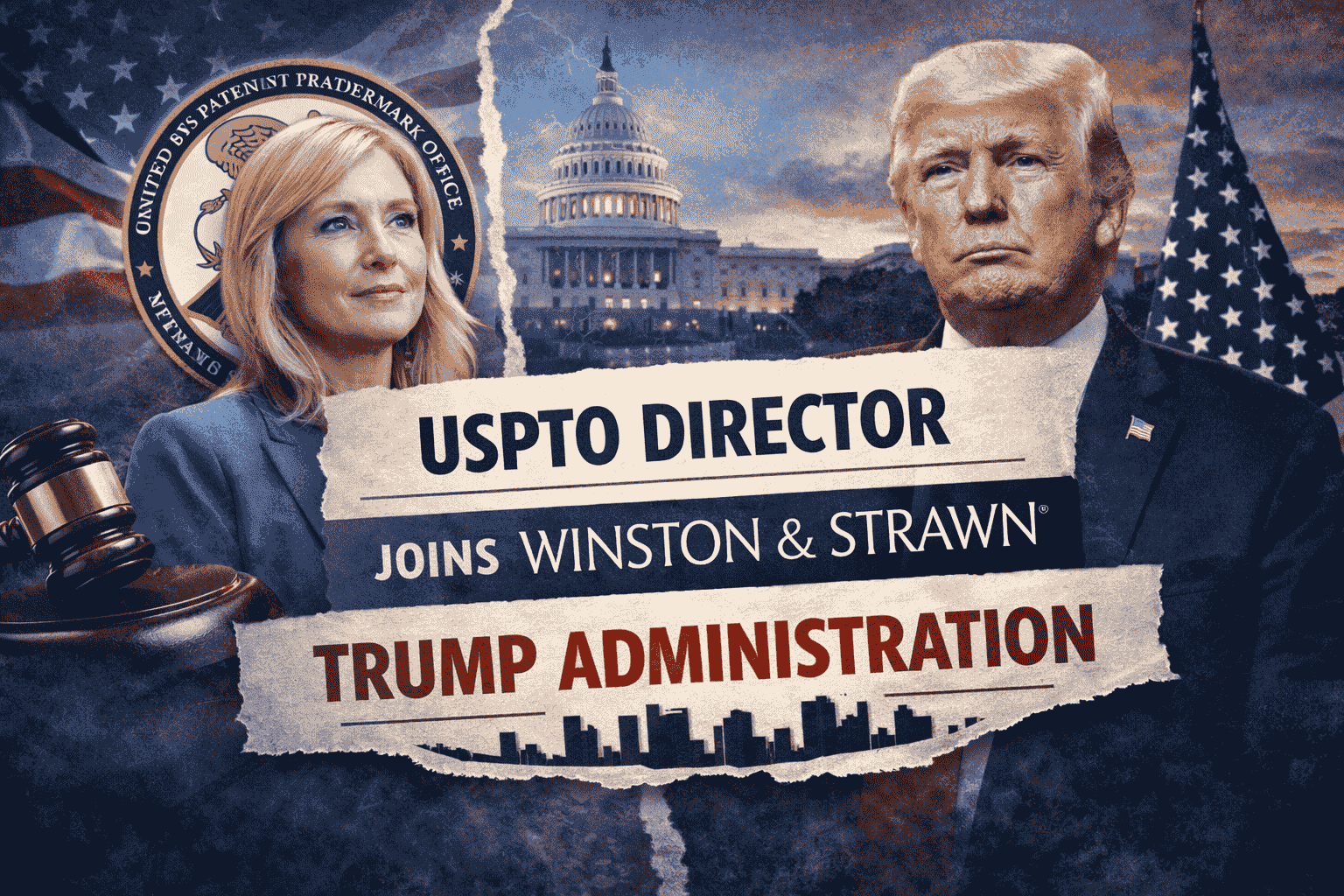
A Major Leadership Shift at the U.S. Patent Office
A significant transition is underway at the U.S. Patent and Trademark Office (USPTO) as Kathi Vidal, the current Under Secretary of Commerce for Intellectual Property and Director of the USPTO, prepares to exit her government role and return to private practice.
Vidal has announced that she will rejoin Winston & Strawn, a major U.S. law firm, in mid-December—just weeks before the incoming Trump administration takes office. Her move is drawing attention across legal, technology, and innovation sectors, particularly amid ongoing debates over artificial intelligence, patent enforcement, and U.S. competitiveness.
From USPTO Leadership Back to Big Law
Before joining the federal government, Vidal led Winston & Strawn’s Silicon Valley office and built a reputation as a leading figure in patent litigation and technology law.
She was nominated to lead the USPTO in 2021 and confirmed by the U.S. Senate the following year. During her tenure, the agency faced unprecedented challenges as innovation accelerated in areas like artificial intelligence, cybersecurity, and global IP competition.
Her upcoming return to Winston & Strawn will place her in senior leadership roles across Silicon Valley and Washington, D.C., where she is expected to advise clients on complex regulatory, litigation, and technology-driven legal risks.
Vidal’s Impact on Patent and AI Policy
While at the USPTO, Vidal oversaw a number of policy initiatives that directly affect patent lawsuits and intellectual property disputes nationwide.
Key areas of focus included:
-
Patentability standards for AI-assisted inventions
-
Transparency requirements in patent filings
-
International intellectual property coordination
-
Addressing racial and gender disparities in innovation and entrepreneurship
Rather than restricting emerging technologies, Vidal emphasized policy frameworks designed to encourage innovation while maintaining legal clarity—a balance that continues to influence patent litigation strategies today.
USPTO Leadership During a Political Transition
Vidal’s departure comes as the agency prepares for a leadership change under President-elect Donald Trump, who has not yet named a new USPTO director.
In the interim, Deputy Director Derrick Brent is expected to assume leadership responsibilities until a permanent appointment is made. This transition period may have implications for pending patent disputes, administrative reviews, and trademark enforcement actions.
Historically, USPTO leadership changes can affect:
-
Patent trial and appeal board (PTAB) decisions
-
Enforcement priorities
-
Guidance on emerging technologies
-
Consistency in trademark and patent review standards
How Patent Policy Could Shift Under Trump
During Trump’s first term, the USPTO was led by Andrei Iancu, whose tenure was often viewed as favorable to patent owners. Since then, the national conversation around patents has evolved—particularly with the rise of AI and big-tech dominance.
Adding complexity, Trump has recently aligned himself with tech figures who have openly criticized traditional patent systems, arguing that patents can sometimes hinder innovation rather than promote it.
Despite these tensions, Vidal emphasized that intellectual property policy has historically remained less partisan than other areas of law, noting that strong IP protection remains central to U.S. economic strength.
Why the USPTO Holds Unique Power
Unlike many federal agencies, the USPTO is not funded by taxpayers. Instead, it operates through the fees collected from patent and trademark filings.
This self-funded structure gives the agency significant operational flexibility and influence over:
-
Patent and trademark adjudication
-
Administrative IP disputes
-
Policy guidance shaping future litigation
For companies involved in patent lawsuits or trademark challenges, leadership philosophy at the USPTO can quietly—but profoundly—impact outcomes.
Vidal’s Next Role: Advising on Tech, AI, and Litigation Risk
Upon returning to Winston & Strawn, Vidal is expected to advise clients on matters involving:
-
Artificial intelligence regulation and patent protection
-
Antitrust and competition law
-
Cybersecurity and data governance
-
Global technology disputes and geopolitical risk
Law firm leadership has indicated that her experience will be particularly valuable as businesses navigate legal disruptions caused by rapid technological advancement and global political pressure.
Why This Matters for Patent Lawsuits and IP Disputes
Vidal’s move highlights a broader trend: senior government IP officials increasingly bring regulatory insight directly into private-sector litigation and advisory roles.
For startups, tech giants, and investors alike, this signals:
-
Heightened scrutiny in patent filings
-
Increased sophistication in IP litigation strategies
-
Closer alignment between regulatory policy and courtroom arguments
Final Takeaway
The return of the USPTO’s top official to private practice—just as a new administration takes power—underscores how closely intellectual property law, politics, and innovation are intertwined.
As leadership changes unfold, patent owners, inventors, and litigators should closely watch how policy direction evolves—and how it may affect ongoing and future lawsuits.
Follow Ongoing IP & Patent Litigation Coverage
At LawsuitIt.com, we cover:
-
Breaking patent and trademark lawsuits
-
USPTO policy changes
-
High-stakes technology and AI litigation
-
Federal agency leadership shifts affecting the courts
👉 Stay informed. Bookmark LawsuitIt.com for daily legal updates.



0 Comments