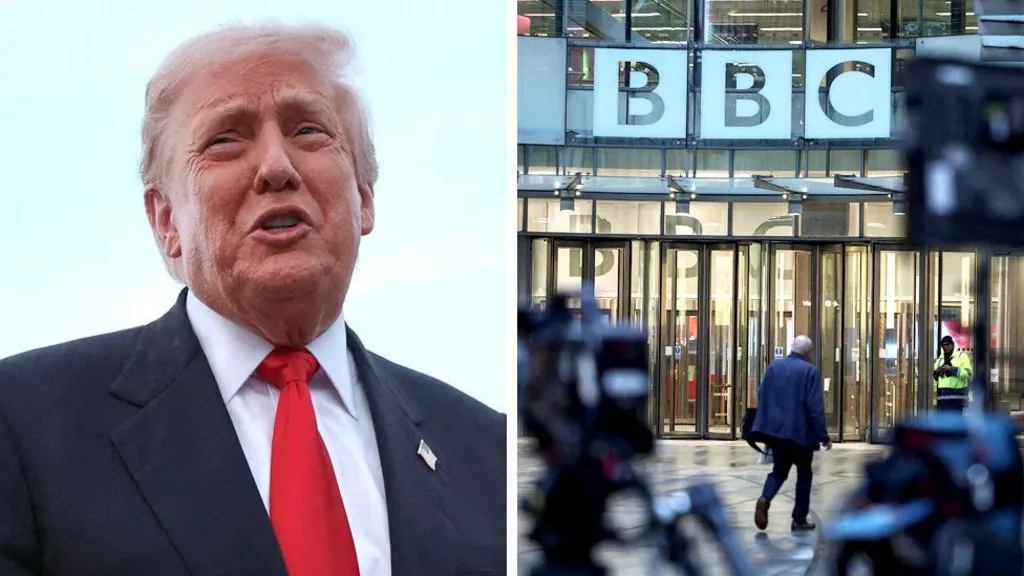
Image Credit: Reuters / AFP via Getty Images
The litigation initiated by United States President Donald Trump against the British Broadcasting Corporation (BBC) represents a watershed moment in the intersection of international media ethics, constitutional law, and geopolitical friction. Filed in the United States District Court for the Southern District of Florida, the lawsuit seeks an unprecedented $10 billion in damages, alleging that the broadcaster engaged in a deliberate campaign of defamation and deceptive trade practices through the manipulation of video footage. This case is not merely a dispute over a television documentary; it serves as a critical examination of the “actual malice” standard in the United States, the jurisdictional reach of state-level trade practice laws in a digital age, and the internal governance of state-funded media institutions.
The Anatomy of the Panorama Controversy
At the center of the litigation is the BBC’s flagship current affairs program, Panorama, and an episode titled “Trump: A Second Chance?”, which aired on October 28, 2024, mere days before the U.S. presidential election. The documentary focused on the events of January 6, 2021, and President Trump’s rhetoric leading up to the breach of the U.S. Capitol. The legal complaint focuses on a specific twelve-second segment where two distinct parts of a seventy-minute speech were spliced together to create what the plaintiff describes as a “fabricated depiction” of his remarks.
The Splicing Mechanism and Narrative Distortion
The documentary presented a sequence where Trump appeared to say, “We’re going to walk down to the Capitol… and I’ll be there with you. And we fight. We fight like hell”. Forensic analysis of the original speech reveals that these statements were separated by approximately fifty-five minutes of intervening rhetoric. In the first segment, delivered at 12:12 p.m. EST, Trump told supporters they would walk to the Capitol to “cheer on our brave senators and congressmen”. The second segment, where he utilized the phrase “fight like hell,” occurred nearly an hour later at 1:07 p.m. EST.
The omission of the “peacefully and patriotically” qualifier is a primary pillar of the defamation claim, as the plaintiff argues it was excluded to satisfy a pre-existing editorial narrative of incitement. The legal argument suggests that by removing the intervening fifty minutes of speech, the BBC created a “false, defamatory, deceptive, disparaging, inflammatory, and malicious depiction” of the President. This specific edit, according to the complaint, was a “brazen attempt to interfere in and influence” the 2024 election.
Comparative Timeline of Speech Segments
The following table illustrates the disparity between the televised edit and the actual sequence of events as recorded in the official transcripts:
| Segment Aspect | BBC Panorama Edit (Oct 2024) | Actual Speech (Jan 6, 2021) | Time Interval/Context |
| Opening Phrase | “We’re going to walk down to the Capitol…” | “We’re going to walk down to the Capitol and we’re going to cheer on our brave senators…” | 12:12 PM EST |
| Middle Phrase | “…and I’ll be there with you.” | “…and I’ll be there with you.” | Part of the 12:12 PM segment |
| Concluding Phrase | “…And we fight. We fight like hell.” | “…And we fight. We fight like hell, and if you don’t fight like hell, you’re not going to have a country anymore.” | 1:07 PM EST (55 mins later) |
| Omitted Context | No mention of peaceful protest. | “I know that everyone here will soon be marching over to the Capitol building to peacefully and patriotically make your voices heard.” | 12:13 PM EST (Omitted by BBC) |
Institutional Admission and Apology
The BBC’s initial response to the growing controversy was characterized by a rare admission of editorial failure. Chairman Samir Shah described the edit as an “error of judgment” and acknowledged that it gave the “mistaken impression” that the President had made a direct call for violent action. Despite this apology and a formal retraction, the corporation has steadfastly maintained that there is no legal basis for a defamation claim, arguing that the edit was an attempt to compress a lengthy speech for time rather than a malicious attempt to deceive.
The BBC’s apology, issued in November 2024, accepted that the edit “unintentionally created the impression that we were showing a single continuous section of the speech”. However, the corporation rejected demands for financial compensation, leading directly to the filing of the lawsuit in December 2025. The refusal to pay compensation was grounded in five main arguments: the lack of U.S. distribution, the lack of harm given the election victory, the absence of malice, the context of the full hour-long program, and the protection of political speech under the First Amendment.
Internal Whistleblowing and the Prescott Memo
The transition from a public relations embarrassment to a multi-billion dollar legal crisis was accelerated by the leak of an internal memo authored by Michael Prescott, a former external advisor to the BBC’s Editorial Guidelines and Standards Committee (EGSC). Prescott, a veteran journalist and corporate advisor, raised alarms regarding what he described as “serious and systemic” problems with the broadcaster’s impartiality.
The Role of Michael Prescott and Hanover Communications
Prescott’s background as a political editor for The Sunday Times and a corporate director for BT provided his critique with significant weight within the industry. His memo alleged that the Panorama edit was not an isolated mistake but emblematic of a broader institutional bias against the Trump administration. The document revealed that concerns about the documentary were raised internally before it aired, but these warnings were purportedly ignored by executive leadership.
However, Prescott’s own role has become a subject of intense debate. Reporting by Byline Times identified Prescott as a “right-wing lobbyist” at Hanover Communications, a firm representing major U.S. tech and media giants with ties to the Trump administration, including Oracle, Meta, and Paramount. This has led to counter-allegations that the leak was part of a coordinated political effort to undermine the BBC’s governance from within.
The Role of Sir Robbie Gibb
The controversy has been further complicated by the involvement of Sir Robbie Gibb, a member of the BBC Board and former communications chief for Theresa May. Gibb, who was involved in the launch of the right-wing news station GB News, has been accused of fostering a “culture war” within the corporation. Internal sources cited by The Guardian suggest that Gibb was instrumental in Prescott’s appointment to the standards committee and “led the charge” in criticizing the BBC’s leadership based on the memo.
Leadership Turnover at the BBC
The disclosure of the Prescott memo led to immediate and severe consequences for the BBC’s leadership. In November 2025, Director-General Tim Davie and Head of News Deborah Turness announced their resignations. Turness noted in her departure statement that the controversy had reached a stage where it was “causing damage to the BBC,” stating that “the buck stops with me”. Tim Davie, who had served as Director-General since 2020, took ultimate responsibility for the mistakes, even while stating that his departure was “entirely my decision”.
| Outgoing Executive | Role | Resignation Date | Cited Reason/Context |
| Tim Davie | Director-General | Nov 2025 | Ultimate responsibility for editorial mistakes |
| Deborah Turness | CEO, BBC News | Nov 2025 | Accountability for the Panorama controversy |
The resignations have left the BBC in a state of governance flux at a time when its funding model and Royal Charter are under critical review by the UK government.
Legal Framework: Defamation and the Actual Malice Standard
The lawsuit filed in Florida seeks $5 billion specifically for defamation, a charge that faces high legal hurdles in the United States due to the First Amendment. As a public official and candidate at the time of the broadcast, President Trump must meet the “actual malice” standard established in the landmark case New York Times Co. v. Sullivan (1964).
Proving Intent and Recklessness
To succeed, the plaintiff’s legal team must demonstrate that the BBC published the edited clip either knowing it was false or with “reckless disregard” for the truth. The complaint argues that the intentional splicing of two distant quotes constitutes a deliberate attempt to misrepresent facts, thereby satisfying the requirement for intent. Furthermore, the memo from Michael Prescott is cited as evidence that the BBC was aware of the misleading nature of the edit—or at least that warnings had been raised—but chose to proceed with the broadcast regardless.
The Challenge of Proving Harm
Another critical component of defamation under U.S. law is the requirement to prove that the false statement caused material harm to the plaintiff’s reputation. The BBC’s defense is expected to leverage the fact that Trump was re-elected shortly after the documentary aired as evidence that no serious reputational or financial damage occurred. In Florida, Trump actually increased his vote share compared to previous campaigns.
However, the lawsuit contends that the broadcast caused “massive economic damage to his brand value” and injured his future financial prospects. Trump’s attorneys are pursuing a claim of “defamation per se,” arguing that the statements were so harmful on their face to his business and presidential interests that material financial harm does not need to be proven for a jury to award damages.
| Defamation Element | Plaintiff’s Argument (Trump) | Defendant’s Argument (BBC) |
| Falsity | The splice created a quote that was never uttered. | The clip was a “reasonable edit” for time and brevity. |
| Actual Malice | Intentional distortion to influence an election. | Standard journalistic practice; no intent to mislead. |
| Harm/Damages | Billions in brand damage and interference. | Re-election proves no material harm was suffered. |
| Jurisdiction | Accessible in Florida via VPN and BritBox. | Geo-blocked; no direct U.S. distribution. |
The Florida Deceptive and Unfair Trade Practices Act (FDUTPA)
The lawsuit includes a second count seeking an additional $5 billion for violations of the Florida Deceptive and Unfair Trade Practices Act (FDUTPA). This statute, often referred to as Florida’s “Little FTC Act,” is designed to protect consumers and legitimate business enterprises from unscrupulous and deceptive commercial practices.
Applying Trade Law to Journalism
The application of FDUTPA to a news organization is a novel and contentious aspect of the case. The plaintiff argues that the BBC, by marketing itself as a “trusted” and “impartial” source of news while allegedly engaging in deceptive editing, committed a deceptive act in the conduct of trade or commerce. Under FDUTPA, an unfair practice is defined as one that “offends established public policy” and is “immoral, unethical, oppressive, or unscrupulous”.
The complaint alleges that the BBC violated the act by “engaging in unfair methods of competition, unconscionable acts or practices and/or unfair or deceptive acts or practices”. This effectively reframes the editorial error as a commercial fraud, suggesting that the BBC “sold” a product (its news reporting) under false pretenses to the global and Florida markets.
Legal Precedents and Challenges
The BBC is likely to move for a dismissal of this count, arguing that news reporting does not constitute “trade or commerce” as defined by the statute. Florida courts have previously held that FDUTPA requires a “consumer transaction” or a “commercial purpose” to be applicable.
- Standing: Some courts have decided FDUTPA only includes individuals deceived when buying or selling goods or services, while others have allowed claims when any person was injured by a deceptive practice.
- Actual Damages: Under FDUTPA, “actual damages” are typically measured as the difference in market value of a product as delivered versus as promised. Applying this to a free or license-funded news broadcast is legally complex.
In a similar case (Pop v. Lulifama.com LLC), the Eleventh Circuit held that FDUTPA claims sounding in fraud must be pleaded with extreme particularity, requiring the “who, what, when, where, and how” of the deceptive act. The BBC will likely argue that the plaintiff fails to establish a direct consumer transaction between the broadcaster and the citizens of Florida.
Jurisdictional Battlegrounds and Digital Distribution
A primary defense for the BBC is the issue of jurisdiction. The corporation asserts that the Panorama documentary was never broadcast in the United States and was geo-blocked on its digital platforms, such as BBC iPlayer, restricting access to viewers within the United Kingdom.
The VPN and BritBox Arguments
President Trump’s legal team counters this by highlighting the increasing prevalence of Virtual Private Networks (VPNs) in Florida, which allow users to bypass geographical restrictions. The complaint cites a “significant increase” in VPN usage following the documentary’s debut as evidence that Florida citizens accessed the content. Furthermore, the lawsuit alleges that the documentary was available through BritBox, a subscription streaming service co-owned by the BBC that operates in North America.
| Platform/Mechanism | BBC Position | Trump Legal Team Position |
| BBC iPlayer | Geographically restricted to the UK. | Accessible via VPNs, which have “skyrocketed” in Florida. |
| BritBox | Separate legal entity; documentary not provided. | Mechanism for Florida residents to view original BBC content. |
| Blue Ant Media | Rights sold internationally, but not for US airing. | Licensee with rights “in North America, including Florida”. |
The Blue Ant Media Distribution Controversy
The role of third-party distributors has also come under scrutiny. The lawsuit mentions Blue Ant Media, a Canadian corporation that held international distribution rights for the documentary. While Blue Ant confirmed it had acquired these rights, it stated that the version it received for international distribution “did not include the edit in question” because the program had been condensed for time. This creates a complex chain of custody for the content, as the defense will argue that the allegedly defamatory material was never actually made available in the Florida market through legitimate channels.
Physical Presence in Coral Gables
To further establish jurisdiction, the plaintiff points to the BBC’s physical presence in Florida, specifically an office in Coral Gables. Additionally, the complaint notes that BBC producers traveled to Mar-a-Lago in Palm Beach to film portions of the documentary. Under Florida Statute 48.193, personal jurisdiction can be established if a foreign defendant engages in “substantial and not isolated business activities” within the state.
Comparative Analysis of Media Law: US vs. UK
The strategic decision to file the lawsuit in Florida rather than the United Kingdom highlights the divergent legal landscapes regarding libel and defamation. In the UK, the burden of proof is often on the defendant to show that a statement is true, whereas, in the US, the plaintiff must prove falsity and malice.
Statute of Limitations
A significant factor in the choice of venue was the expiration of the UK’s one-year statute of limitations for libel claims. Since the documentary aired in October 2024 and the legal action was formalized in late 2025, the plaintiff was legally barred from pursuing the case in British courts. Florida law offers a longer window for filing such claims, making it the only viable venue for a multi-billion dollar action.
The “Chilling Effect” on Global Journalism
The Committee to Protect Journalists (CPJ) and other media advocacy groups have condemned the lawsuit as an attack on press freedom. They argue that the use of multi-billion dollar lawsuits by high-ranking government officials creates a “chilling effect,” where newsrooms may engage in self-censorship to avoid the risk of financially ruinous litigation.
This case is seen as part of a broader trend of “lawfare,” where legal systems are leveraged to retaliate against critical coverage. Since 2015, Donald Trump and his businesses have reportedly been involved in 34 media or defamation lawsuits. The current action is described by some commentators as “grievance politics with a purpose,” intended to disciplining the media rather than simply seeking a correction.
Analyzing the $10 Billion Valuation
The $10 billion figure is viewed by many legal experts as an “exaggerated” sum designed for political impact rather than a realistic assessment of damages. For context, other recent settlements involving President Trump and major media outlets have been significantly lower:
| Defendant | Year | Settlement Amount | Allegation Focus |
| ABC News | 2024 | $15 Million | Comments by George Stephanopoulos |
| CBS News | 2024 | $16 Million | Selective editing of a Kamala Harris interview |
| BBC (Requested) | 2025 | $10 Billion | Panorama edit of Jan 6 speech |
The massive discrepancy—a thousand-fold increase over previous settlements—suggests that the Florida lawsuit is intended to serve as a powerful signal to international media outlets. Chris Ruddy, CEO of Newsmax and an ally of Trump, has suggested that the litigation process itself could cost the BBC between $50 million and $100 million, regardless of the eventual outcome.
Institutional Impact and the BBC Charter Review
The timing of the lawsuit is particularly precarious for the BBC, as it coincides with a major review of its Royal Charter and funding model. The current charter expires in 2027, and the broadcaster is already facing significant financial pressure.
Funding Risks and Public Perception
The potential for a multi-billion dollar settlement or an expensive, protracted legal battle in the U.S. has led to speculation that the cost could ultimately be borne by the British taxpayer through an increase in the annual license fee, which currently stands at £174.50 ($234). UK politicians, including Shadow Culture Secretary Nigel Huddleston, have expressed concerns that a $10 billion claim could effectively bankrupt the institution or force a radical change in its funding structure, such as moving toward a subscription-based model.
Political Stance in the United Kingdom
The British government, led by Prime Minister Keir Starmer, has emphasized the importance of the BBC’s independence while urging the corporation to correct mistakes quickly to maintain public trust. Culture Secretary Lisa Nandy has stated that the BBC must be “fiercely independent” and “accountable,” but has also noted that its editorial standards have at times been “not robust enough”.
Political appointments to the BBC board, such as Sir Robbie Gibb, are expected to be scrutinized during the charter review. Critics argue that these appointments have damaged confidence in the BBC’s impartiality.
Synthesis of Arguments and Potential Outcomes
The legal debate rests on the distinction between “editorial compression” and “deceptive fabrication.” The BBC maintains that it is standard journalistic practice to edit longer speeches for time. However, the specific manner in which the clips were spliced—removing 55 minutes of context to link “walk to the Capitol” directly with “fight like hell”—creates a phrase that the plaintiff physically never spoke.
Potential Legal Paths
- Summary Dismissal: The court, overseen by US District Judge Roy Altman, may find that the BBC lacks a sufficient jurisdictional footprint in Florida or that the First Amendment provides absolute protection for the edit.
- Settlement: To avoid the risk of a high-profile trial and the associated costs, the BBC could choose to pay a significant settlement, following the precedents set by ABC and CBS.
- Discovery and Trial: A trial in Florida would lead to an extensive discovery process, potentially forcing the BBC to reveal internal communications and draft versions of the documentary.
Broader Media Implications
The case has already prompted media organizations to re-evaluate their editing protocols for political speeches. The resignation of top BBC leadership serves as a stark reminder of the professional risks associated with narrative-driven journalism in a highly polarized environment. As the BBC enters its charter review, the shadow of this lawsuit will likely influence debates over its impartiality, funding, and the role of state-supported media in a globalized digital economy.
Conclusion
The $10 billion lawsuit filed by President Trump against the BBC serves as a definitive marker in the evolution of media litigation. It combines the high standards of U.S. constitutional law with the expansive reach of state-level trade statutes and the complexities of modern digital distribution. The case highlights a profound failure in the BBC’s internal editorial controls, as evidenced by the resignations of its most senior executives and the damning memo from a former advisor.
While the legal hurdles for the plaintiff remain formidable—particularly regarding the “actual malice” requirement and the demonstration of material harm following a successful election—the mere existence of the lawsuit has already achieved significant political and institutional objectives. It has forced a global conversation on the ethics of video splicing, exposed deep fissures within the UK’s most prominent media institution, and challenged the traditional boundaries of jurisdictional authority in the internet era.
The resolution of this case will signal whether global media can continue to rely on traditional defenses of “editorial judgment” or if they must prepare for a new era of high-stakes, cross-border accountability where the cost of a single edit can be measured in billions. The future of the BBC’s funding and independence hangs in the balance as the corporation prepares to defend itself in the Southern District of Florida.


0 Comments